Production Slowed in Q2, but Thermal Prices Stronger than Expected
I’ve mentioned in the last few pieces that while Peabody and Alpha are absolute beasts to put together, HCC is by comparison pretty easy, as it’s just two mines. Well thankfully today’s rundown of tomorrow’s CEIX earnings expectations falls into the latter category (just four mines), although it does have some nuances that need to be accounted for.
First off, let me just point out that I had pretty low expectations for thermal coal markets coming into the year. Domestic and global gas markets were oversupplied, inventories were high, demand wasn’t great…let’s just say there were a lot of issues. But the ongoing AI datacenter buildout narrative has really breathed some life back into future power demand prospects. And the market has actually proven to be tight enough that any buying pressure has resulted in decent prices.
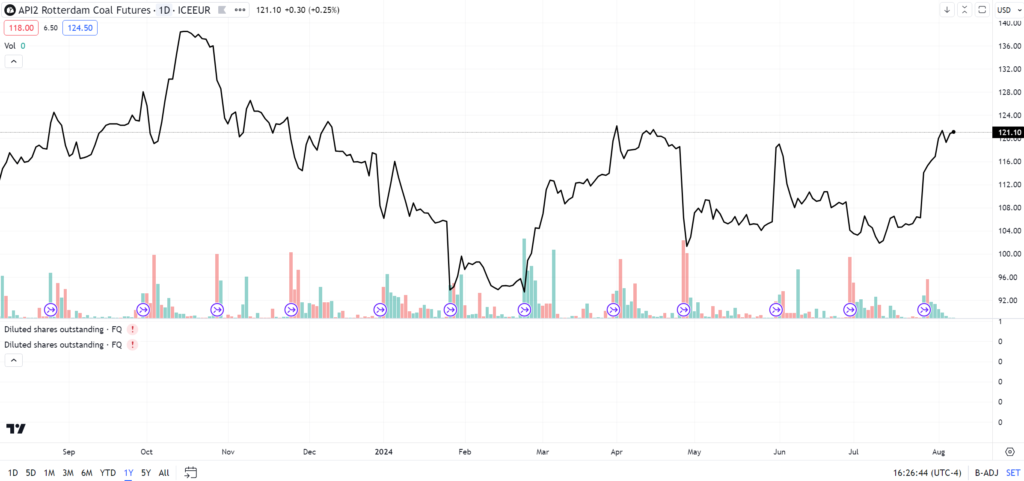
Source: Tradingview
And that price range actually bodes pretty well for CEIX, as they are one of, if not THE lowest cost thermal coal providers into Europe. So with that in mind, let’s dive in and see how close we can get…
The biggest issue for the company was the collapse of the Francis Scott Key Bridge in Baltimore, which left the company without significant access to its largest market from late March until mid-May. To account for this, I cut export assumptions in half, and assumed the remaining production was sent to domestic customers.
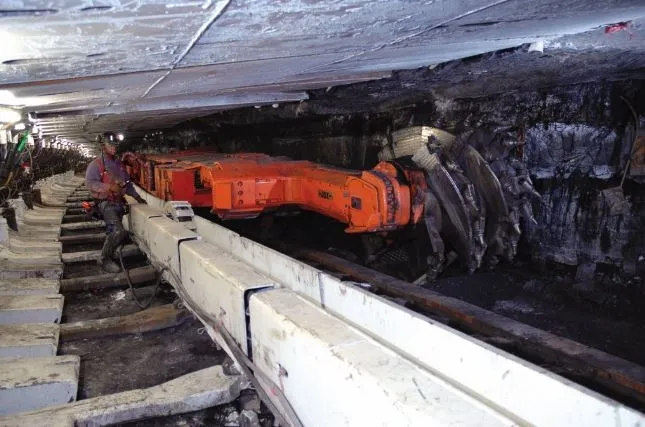
The company operates four total mines. Three of these are big longwall thermal coal operations – Bailey, Enlow Fork, and Harvey – which comprise the company’s Pennsylvania Mining Complex, and Itmann, which is a small low-volatile metallurgical coal operation in southern West Virginia. Production for those mines is listed in the table below, along with their MSHA ID numbers.

Source: MSHA, Seawolf Research
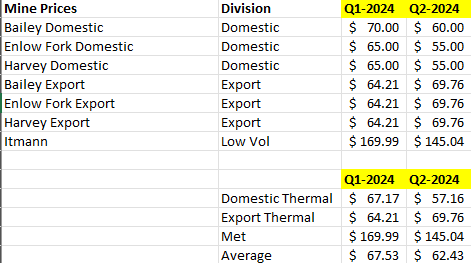
The bridge outage in Baltimore caused production to decline over 20% in Q2 from 6.5 to 5.2 million short tons, so clearly top line numbers are going to take a hit. On the other hand, seaborne thermal coal prices actually went UP during shoulder season. And the forward curve is now positioned even higher, which means that CEIX may be able to make up some of that lost revenue going forward. My price assumptions for each mine/delivery point are listed below.
Source: Seawolf Research
CEIX reported an average per ton coal revenue of $68.33/st in Q1, so we’re in the ballpark here. Domestic thermal coal prices were lower in Q2 and so have been reflected here.
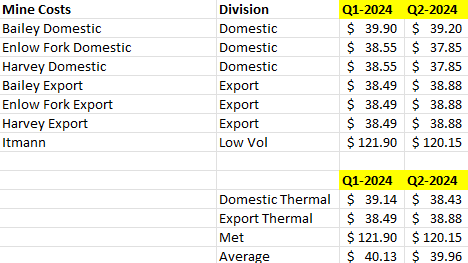
Like HCC, costs for CEIX are also pretty straightforward as they only have four mines, so I’ll just post my mine-level calculations here.
Source: Seawolf Research
CEIX reported Q1 cash costs of $40.29 so no need to adjust here, we can just move on to results.
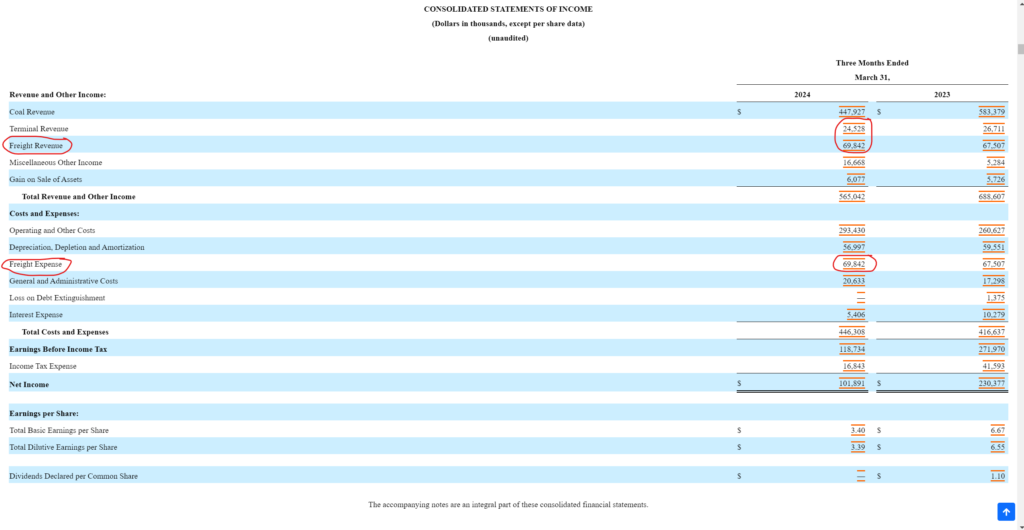
The one thing I should point out here to anyone looking through these results for the first time is that CONSOL also reports cost and revenue from freight, as they export coal for others as part of that business.
Source: Company Filings
That ~$70M of costs are offsetting, but we need to add them in to the coal revenue results to compare top line numbers. When I do that to the results below, I get $540.2M in revenue, which is pretty close to the $565M reported.
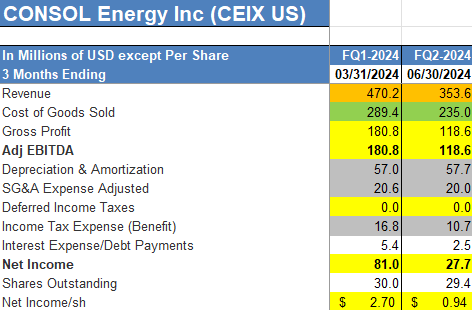
Source: Seawolf Research
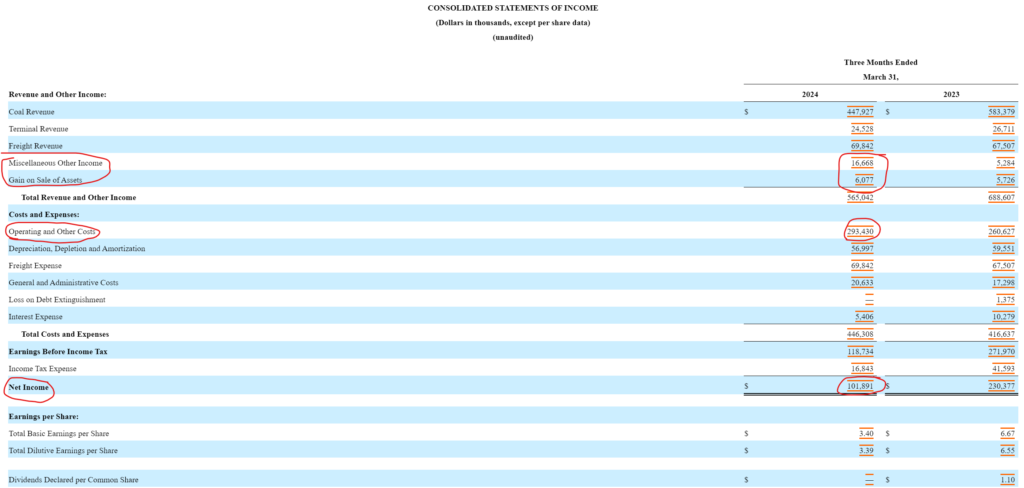
Costs are also in line and net income is only off by $20M, which is due to “Miscellaneous other income” and “Gain on Sale of Assets” noted two screenshots above. And when I add that in to revenue, earnings per share come in spot on with the company’s Q1 reported number at $3.39/sh.
That also likely means our Q2 Revenue and net income estimates of ~$420M (including a ~$70M proxy for freight) and $27M or $0.94/share are reasonable. And unsurprisingly, each fall right in line with current estimates.
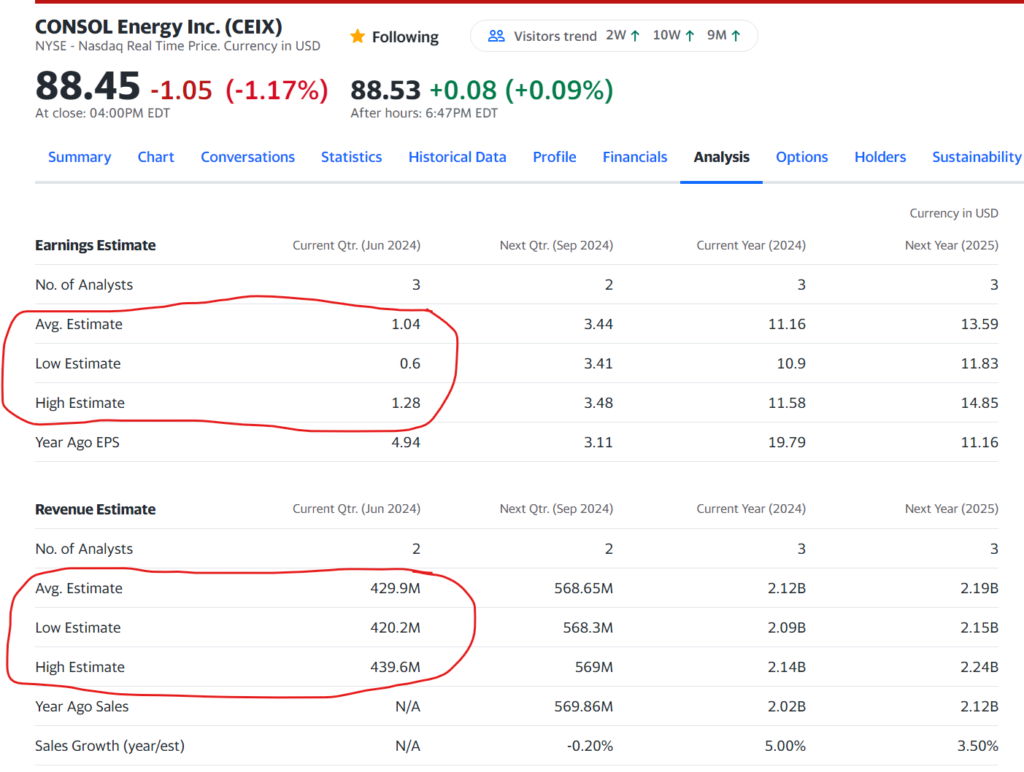
Source: Seawolf Research
So while likely not a great quarter, it wasn’t really a bad one either. But just a quick peek forward at the next two quarters – with all of these assumptions pulled forward at the current curve prices of ~$125 for API2 Coal show that both revenue and earnings are set to accelerate big time.
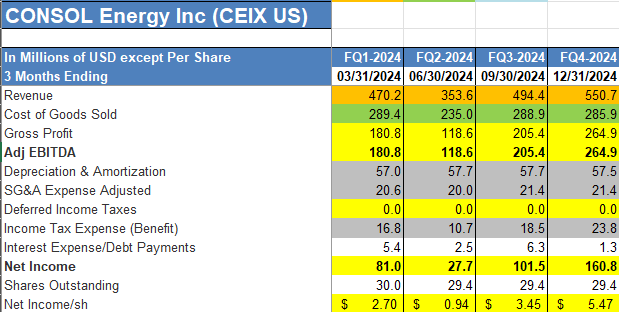
Source: Seawolf Research
That’s a whole lot of money to juice their buyback, even if thermal coal corrects in the shoulder season.
Given the recent selloff due to broader market pressures, this has become a name to think about accumulating for a potential price run in winter…assuming we have one this year!